




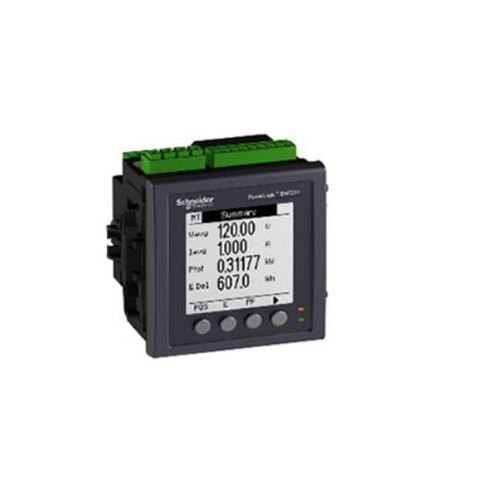
Schneider Maximum Demand Controller
25000.0 INR/Piece
Product Details:
- Contact Material Silver Alloy
- Ambient Temperature -10C to +55C Celsius (oC)
- Contact Resistance <50 m Milliohm (m)
- Contact Form SPDT (Single Pole Double Throw)
- Protect Feature Epoxy
- Power Consumption <5VA Volt (V)
- Working Temperature 0C to 50C Celsius (oC)
- Click to View more
X
Schneider Maximum Demand Controller Price And Quantity
- 1 Piece
- 25000.0 INR/Piece
Schneider Maximum Demand Controller Product Specifications
- <50 m Milliohm (m)
- Screw Terminal
- Microcontroller Based Demand Monitoring
- >100M at 500V DC
- 0C to 50C Celsius (oC)
- Miniature
- -10C to +55C Celsius (oC)
- 230V AC / 415V AC Volt (V)
- <5VA Volt (V)
- Black
- Back/Side entry (as per model)
- Epoxy
- Approx. 650g Grams (g)
- Maximum Demand Controller
- 96x96x65 mm (refer model details) Millimeter (mm)
- SPDT (Single Pole Double Throw)
- 1 Year
- 5A at 230V AC (resistive)
- Automatic Monitoring & Controlling of Power Demand
- Silver Alloy
- User Programmable Set Points
- IS/IEC 61010-1
- LED Digital Display
- Flame Retardant ABS Plastic
- Optional RS-485 MODBUS
- Manual/Automatic Reset Options
- Audio-Visual Alarm
- Panel Mounting
- CT Secondary 5A / PT Secondary 110V
Schneider Maximum Demand Controller Trade Information
- 1000 Piece Per Month
- 7 Days
Product Description
Description:Comes with unique features in TOU, Hi-Lo profiles, 3 change-over potential free relay outputs, ensures better management of electrical energy usage
- High visibility bright red LED display. Digital readout of 7 digits. Instantaneous parameters of 4 digit, Energy Parameter of 6 digits.
- Maximized resolution through floating decimal point with auto scaling Kilo to Mega values.
- Accuracy class 1.0 & 0.5
- TOU for all integrated parameters programmable for 6 seasons in a year, 3 weekend profiles in a season, 10 Public holidays & 8 tariff zones per day.
- Security: Access to set & clear functions through user programmable codes
- Records Hi Lo profile with 4 peaks & 4 lows
- 3 Potential free relay configurable for
o Predictive demand >UL
o Demand > UL
Benefits:
- Optimises demand utilization
- Analyses electrical faults & planning of load schedule
- Facilitates tripping of non essential loads
- Improves system efficiency
Application:
- Demand Management
- Monitor large loads which contribute to demand peak
- Sub metering of loads, feeders, equipment on continuous basis for cost allocation & analysis.
Advanced Demand Management
Schneiders Maximum Demand Controller leverages microcontroller-based technology to monitor and control electrical demand in real time. The LED digital display provides clear visibility of current demand levels, while manual and automatic reset options ensure seamless operation. Built to withstand rigorous conditions, it enhances efficiency and prevents power demand penalties.
Flexible Installation and Operation
This controller features a compact, flame retardant ABS enclosure suitable for panel mounting. Installation is facilitated by screw terminals and flexible supply terminal entry points, making it compatible with various electrical setups. The miniature design (96x96x65 mm) allows for integration in tight spaces, supporting both back and side entries depending on the model.
Reliable Safety and Compliance
Safety is assured with compliance to IS/IEC 61010-1 standards and robust design features, including epoxy protection and insulation resistance over 100 M at 500V DC. The controller is built for longevity, with mechanical life of approximately 1 million operations and contact load rated at 5A/230V AC (resistive), making it ideal for demanding applications.
FAQs of Schneider Maximum Demand Controller:
Q: How does the Schneider Maximum Demand Controller help manage power demand automatically?
A: The controller continuously monitors electrical demand using CT and PT signals, processing data via its microcontroller to control and limit demand peaks, thereby optimizing energy usage and preventing penalties for excess consumption.Q: What are the advantages of using the user programmable set points on this controller?
A: User programmable set points allow customization of demand thresholds according to specific operational requirements, ensuring tailored control and more efficient power management for different installation environments.Q: When should the alarm output be used and how does it function?
A: The audio-visual alarm activates when power demand exceeds preset thresholds, alerting operators instantly. This prompt warning assists in taking corrective actions to maintain safe and efficient system operation.Q: Where can the demand controller be installed within an electrical setup?
A: Designed for panel mounting, the controller fits in control panels or distribution boards. Its compact size and flexible terminal entry options make it suitable for both retrofit and new installations.Q: What process is involved in resetting the controller after an alarm is triggered?
A: The device offers both manual and automatic reset functionalities. Operators can manually reset using the front panel, or configure automatic reset if continuous operation and minimal manual intervention are required.Q: How does the optional RS-485 MODBUS communication benefit system integration?
A: The RS-485 MODBUS option enables efficient remote monitoring and control, allowing operators to integrate the controller with building management or SCADA systems for enhanced data visibility and centralized control.Q: What usage scenarios are ideal for this maximum demand controller?
A: It is best suited for automatic monitoring and controlling of electrical load in industrial, commercial, and institutional environments, helping users sustain efficient operation and avoid excess demand penalties.Tell us about your requirement

Price:
Quantity
Select Unit
- 50
- 100
- 200
- 250
- 500
- 1000+
Additional detail
Mobile number
Email


Contact Details
ENSAVE ENERGY PVT. LTD.
GST : 24AADCE7796D1ZI

- B No. 416/B, Galaxy Mall, Opp. Jhansi Rani BRTS Stop, Satellite Road, Ahmedabad - 380015, Gujarat, India
- Phone : 08071779496

- Mr Chintan Shah (Director)
- Mobile : 08071779496
- Send Inquiry
 Send Inquiry
 Send Inquiry
 Send SMS
 Call Me Free
ENSAVE ENERGY PVT. LTD.
All Rights Reserved.(Terms of Use)
Developed and Managed by Infocom Network Private Limited.
Developed and Managed by Infocom Network Private Limited.

